

The Gut Has a Data Problem
From diagnosis by exclusion to daily variability, digestive health is missing the infrastructure other biological systems already have.

For all the attention gut health has received in recent years, the data layer underneath it is surprisingly thin. The wellness industry has built an entire category around supporting, repairing, and optimizing the gut. But the infrastructure for measuring what is happening in there has not kept pace. Most people have no continuous readout of gut function. Most doctors, faced with a patient reporting chronic GI symptoms, are working solely from descriptions.
Compare that to how we measure the heart, or sleep, or glucose. Each has decades of tracking infrastructure behind it, tools designed to close the feedback loop between a behavior and its biological effect. The gut has almost none of that. The most common GI disorders are diagnosed by exclusion, meaning clinicians work through what something is not before arriving at what it might be.
For patients, that process often takes years. For anyone trying to understand or improve gut function, it means operating with very little signal. That is the data problem this post will unpack, highlighting three key reasons why it persists.
1. Designed for Measurable Disease
When most people think about medical testing, they assume that if a problem exists, a test can measure it. In gastroenterology, that assumption breaks down often.
GI medicine is exceptionally good at finding structural damage. Colonoscopies detect polyps and inflammation. Imaging catches obstructions and tumors. Blood work flags infection and immune activity. These tools answer one question: is something visibly wrong?
The trouble is that the most common digestive disorders are not structural. IBS and the other disorders of gut-brain interaction involve motility, nerve signaling, visceral sensitivity, and immune regulation, not visible tissue damage. A patient can have severe symptoms while every scan, scope, and blood panel comes back clean.
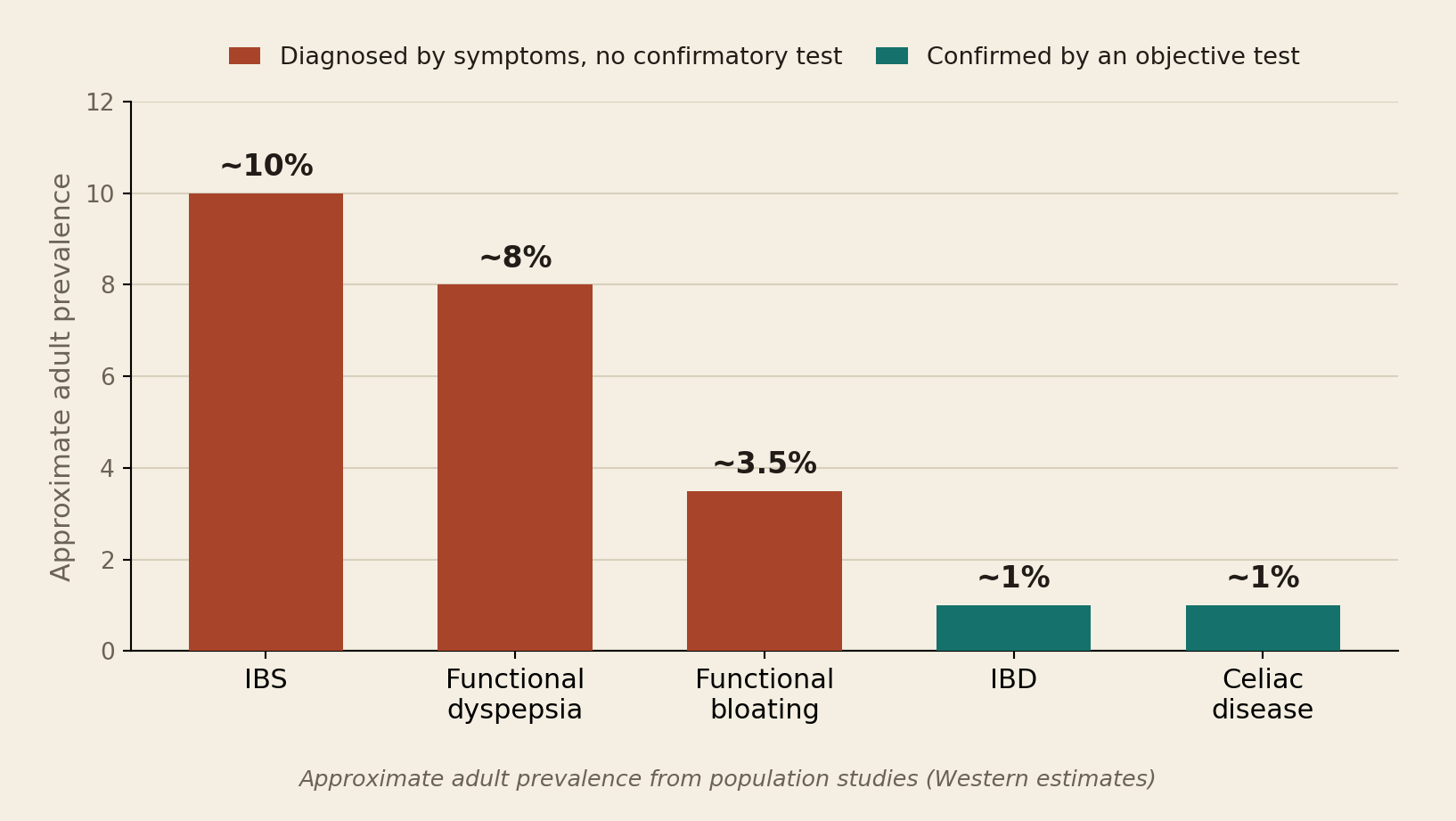
The two colors in that chart capture the core issue. A small set of gut conditions like inflammatory bowel disease and celiac disease have clear confirmatory tests. The far more common functional disorders do not. Without a definitive marker, diagnosis becomes a process of elimination. Clinicians rule out measurable conditions one by one until what remains is labeled functional. For patients, that path is often slow, fragmented, and frustratingly indirect.
2. The Sensation Gap
The absence of functional measurement creates a second issue: when objective data is limited, subjective experience becomes the primary signal.
Few biological systems respond to behavior as quickly as the gut. Dietary changes, stress, sleep disruption, alcohol, or even social context can trigger noticeable changes in digestion within hours. The problem is that subjective experience is often a poor proxy for what is happening at the biological level.
Recent research highlights this challenge. In a 2024 study in the Journal of Clinical Medicine, researchers tested how well those impressions align with objective measurement. They used intestinal ultrasound to assess what was physically in patients' bowels and compared it to what those same patients reported.
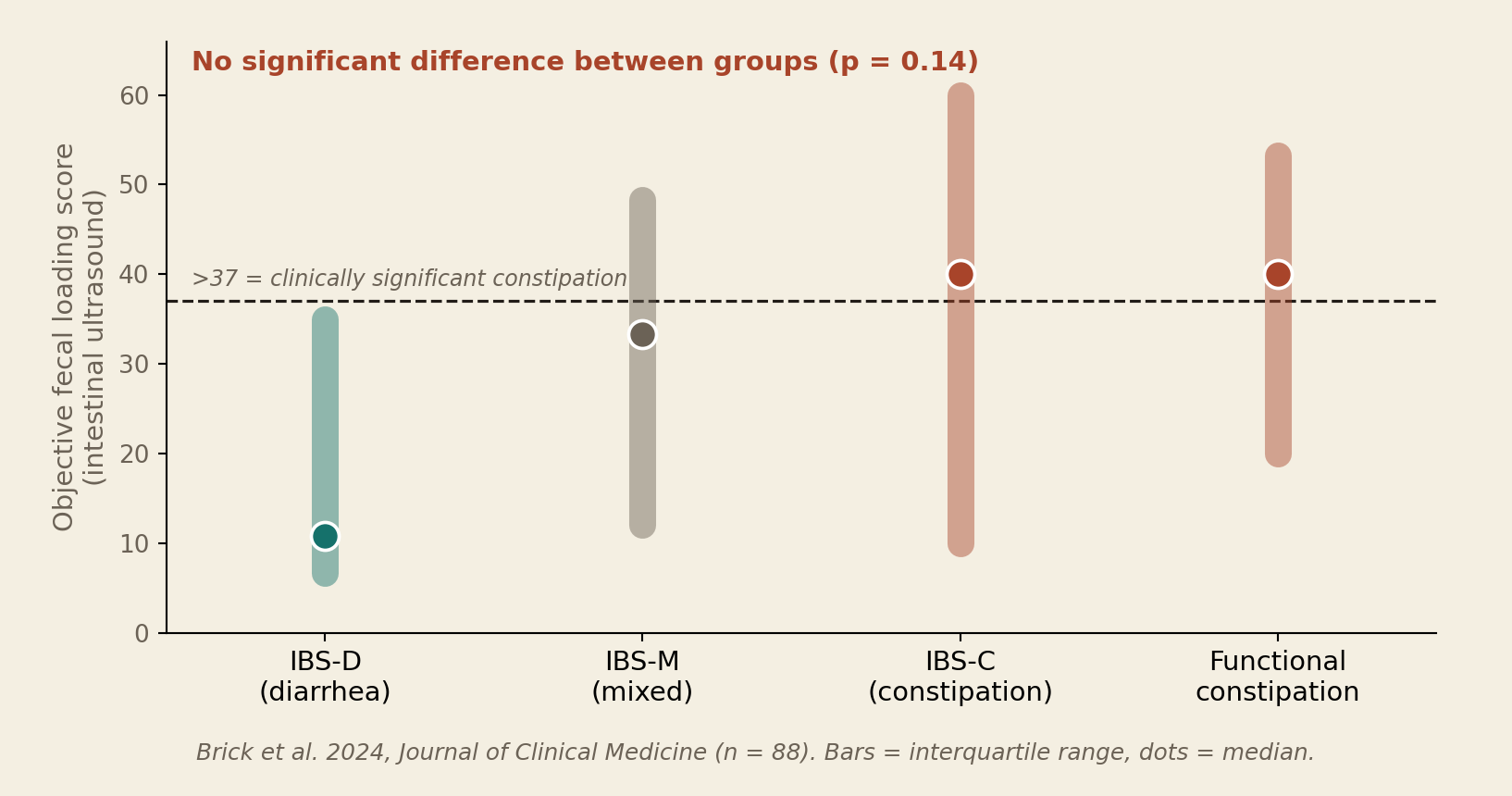
The two correlated poorly. Patients with very different symptom profiles often showed substantial overlap on the objective measure, and the relationship between what patients reported and what the scan found was relatively weak. None of that makes the symptoms any less real. It simply illustrates how difficult it is to infer underlying biology from sensation alone. For many patients, the experience itself becomes both the signal and the evidence.
3. The Snapshot Problem
Even if we solved the first two problems, a third challenge remains. The gut is not a static system. It responds continuously to behavioral inputs, from what someone ate to the environment they live in. As life changes, so does the gut. The challenge is that most of our measurement tools were not built to capture the daily realities of our microbiome.
Research suggests that this variability is far greater than many people realize. In a 2021 study in Nature Communications, researchers sampled the same individuals’ gut microbiomes every day for six weeks. For 78% of bacterial types, within-person variation over time exceeded variation between different people. Some bacteria shifted by as much as 100-fold between consecutive days. That is not a gradual drift, but rather a system that can look completely different from one day to the next.
Other health domains solved this problem through continuous monitoring. Glucose management changed when finger-stick measurements gave way to continuous glucose monitors. Fitness changed when occasional weigh-ins gave way to wearables generating thousands of observations per day. The gut has not yet undergone a similar transition. Most digestive decisions are still being made from isolated snapshots.
Takeaways
The gut is the hardest organ to track because everything about it resists measurement. Diagnostic tools miss the most common conditions, the feedback is largely subjective, and the system never holds still long enough to read cleanly. Each problem makes the next even harder to solve, and most digestive health decisions are still being made partially in the dark.
The standard tests were built to find structural damage, but the conditions affecting the most people are largely functional.
Without an objective readout, people fall back on sensation, which tracks poorly with what is happening at the biological level.
Even a good measurement is only a snapshot of a system that can shift drastically across days.
The future of gut measurement looks less like a sharper test and more like a longer one. A single reading cannot survive a system that swings this much, but a dense stream of readings from the same person, gathered over weeks and months, turns that noise into a personal baseline. That is the shift many other domains of health have already made.
From there, the inputs matter as much as the outputs. Pairing a long record of how someone feels and functions with what they were eating, sleeping, and managing is what turns scattered data points into cause and effect. That is the data the gut has never had, and assembling it is the difference between guesswork and understanding.
Wow - this is fascinating! I wish we could "assemble that data" and have some real understanding of this. Absolutely fascinating!
wow.... ryan. another good one.
now, all i'm thinking of is how to starve myself because everytime i have any GI issue, it's either "cleansing options", lol or stop eating. 😢