

Inside Ultra-Processed Foods
The evidence connecting emulsifiers to microbiome changes, mucus-layer damage, and IBD risk.

Few topics in nutrition have moved as fast as ultra-processed food. A term that barely existed in public conversation fifteen years ago is now embedded in national dietary guidelines, contested in legislatures, and cited for nearly every modern health problem from weight gain to mental health.
Most of that attention lands on the same explanation: these foods are engineered, calorie-dense, and easy to overeat. For general health, that’s a real part of the story. For the gut, it’s largely beside the point. The mechanism doing the most specific damage there isn’t about how many calories a food delivers or how it’s flavored. It's about emulsifiers, the detergent-like additives that hold a product together on the shelf, and the mucus barrier in your gut they were never meant to touch.
This post covers that barrier, the controlled human trial that tested what happens when it's exposed to one common emulsifier, and the population-level pattern that shows up across 116,000 people tracked for nearly a decade.
The Barrier Under Attack
Your intestinal lining is not in direct contact with your gut bacteria. Between the two sits a mucus layer, and its entire job is to hold those bacteria at a physical distance from the cells lining your intestine. That separation is one of the primary ways the intestine protects itself from the trillions of microbes living inside it. Anything that weakens that layer is compromising one of the gut's primary defenses.
Emulsifiers function like detergents. They keep oil and water from separating, which is why they appear in ice cream, salad dressing, packaged bread, and almost every sauce sold in a jar. Researchers wondered whether detergent-like molecules repeatedly passing over that mucus layer could slowly erode the barrier designed to keep bacteria at a safe distance.
In 2015 they tested it. Mice given relatively low concentrations of two common emulsifiers developed low-grade inflammation and metabolic syndrome. Furthermore, mice already predisposed to colitis developed robust colitis. In both cases, their bacteria moved in closer to the intestinal wall than they should have been able to (Nature).
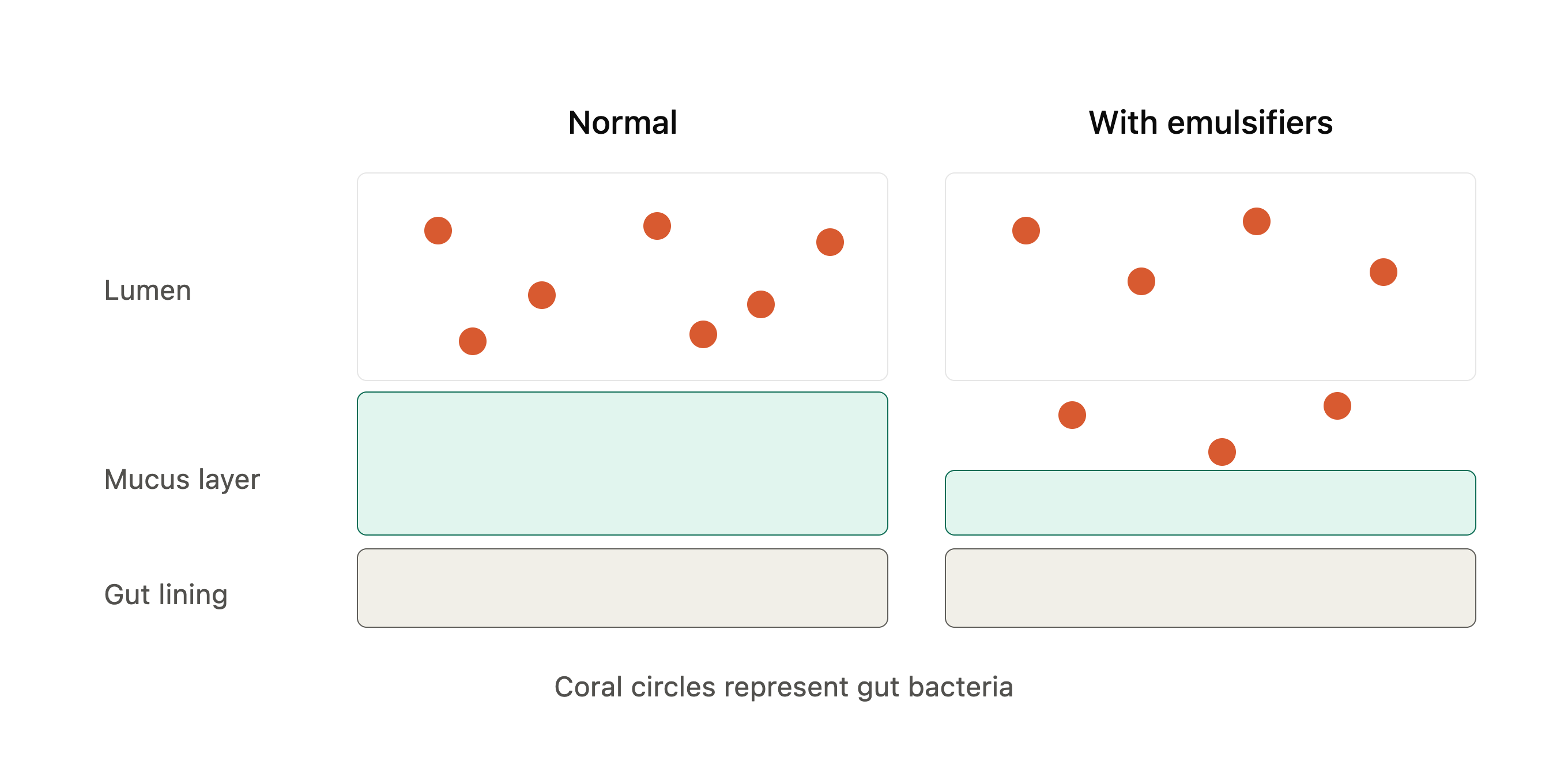
What made the study especially convincing came next. They transferred the altered microbiota into germ-free mice, animals raised with no bacteria of their own, and those mice developed the same inflammation. That proved causality and passed a bar most nutrition research never clears, further strengthening the case against emulsifiers and the necessity to learn more about their impact.
Then Came the Human Trial
Mice are not people, and a finding this clean in a rodent model has an obligation to survive a human test before anyone acts on it.
Six years later, researchers tested the question in humans. A double-blind controlled feeding study put 16 healthy adults on a diet containing no emulsifiers at all. Seven of them had 15 grams a day of carboxymethylcellulose added to otherwise identical food. Neither the participants nor the researchers evaluating them knew who was in which group (Gastroenterology).
After eleven days, the group receiving the emulsifier reported more abdominal discomfort after meals. Their microbiome composition shifted and lost diversity. Their stool chemistry changed as well, showing reductions in short-chain fatty acids, the compounds gut bacteria produce from fiber that feed the cells lining the colon and help keep inflammation in check.
Two of the seven even showed exactly what the mouse finding predicted: bacteria encroaching into the mucus layer meant to stay clear. While the study was small, it showed that the mechanism observed in mice could also be detected in people under controlled conditions.
Population-Level Risk Factors
Mice showed the mechanism. The double-blind trial showed it happens in humans. The last question is whether those findings translate into disease risk across an actual population.
Researchers followed 116,087 adults in 21 countries for close to a decade, tracking who developed inflammatory bowel disease and how their diet predicted it. The people eating the most ultra-processed food carried the highest risk, and it rose in line with their consumption (BMJ).
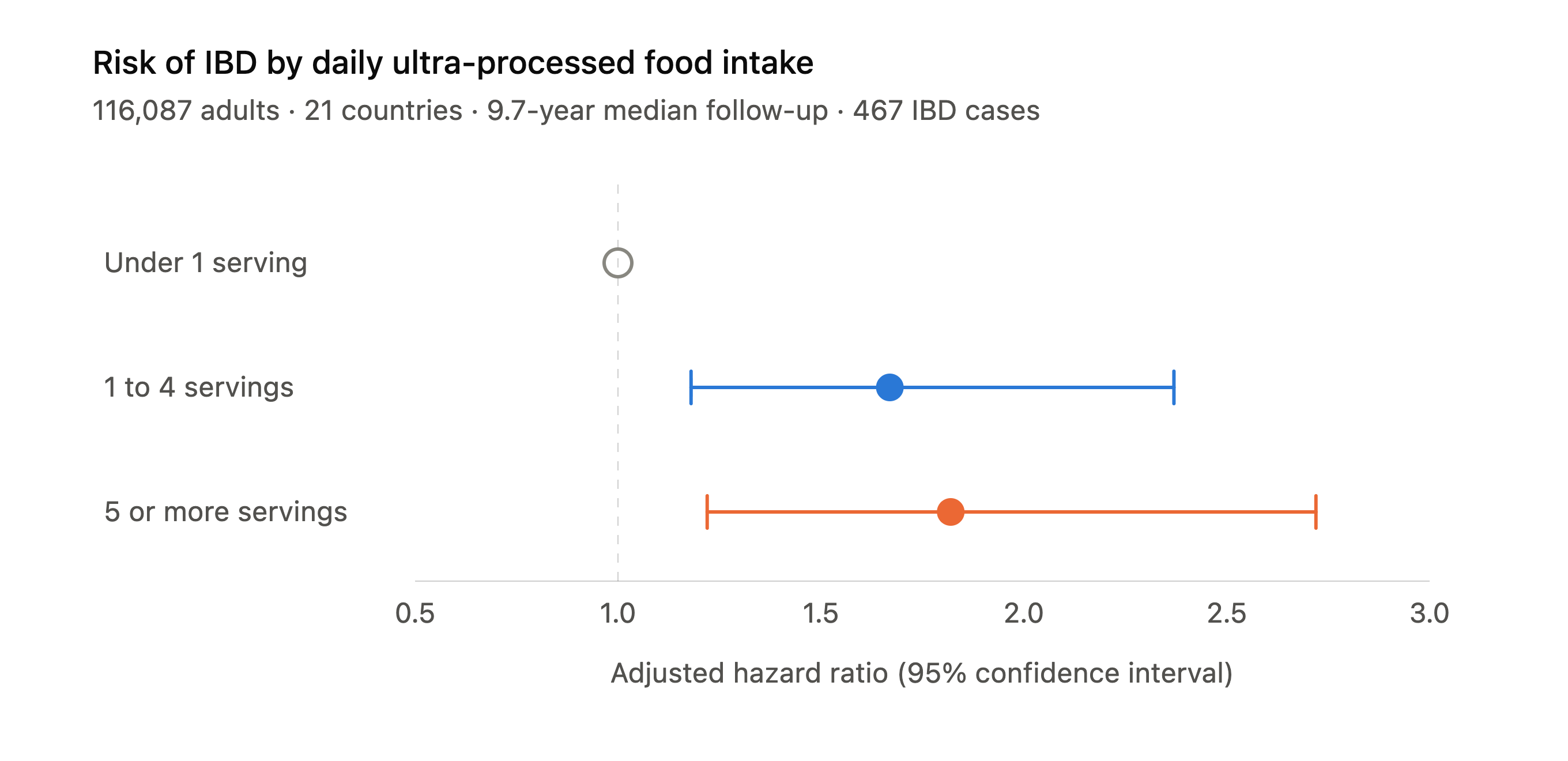
What sharpens this finding is which specific foods were driving it. Soft drinks, refined sweetened foods, salty snacks, and processed meat each carried their own independent association with IBD risk, on top of the overall dose-response pattern above. Meanwhile, white meat, red meat, dairy, starch, and fruit, vegetables, and legumes showed no association at all, in the same cohort, using the same methods. It wasn't food volume, and it wasn't a particular macronutrient. It was a specific slice of the ultra-processed category.
Five or more servings a day sounds like an extreme diet. For a lot of people it isn't. On average, Americans get around 55% of their daily calories from ultra processed foods (CDC). Packaged cereal, flavored yogurt, deli meat, a soda, something from a box for dessert, and the count is there without anyone consciously trying to eat "processed." For many Americans, the highest-risk category is closer to an ordinary day than they might assume.
Takeaways
The case against ultra-processed food usually gets argued on calories and unintentional overeating. For the gut specifically, the sharper problem is physical, and it holds up at every scale researchers have tested it: a mouse model, a controlled human trial, and a population followed for a decade.
The mice proved it’s causal, not just correlated. Emulsifiers act as detergents on the gut’s mucus barrier, and transferring the altered microbiota alone into germ-free mice reproduced the same disease.
Eleven days was enough to see it in real people. A blinded human trial found one common emulsifier lowered microbiome diversity and caused measurable mucus-layer encroachment.
At population scale, the risk was undeniable. Across over 100,000 adults tracked for nearly a decade, IBD risk climbed with intake from specific categories while whole foods showed none.
The research doesn’t suggest that every packaged food is harmful or that every emulsifier should be avoided. Instead, it points to a more useful way of thinking about ultra-processed foods. Your gut doesn't know whether a food came from a factory. It responds to the molecules that reach its lining. For emulsifiers, evidence from animal studies, controlled human trials, and large population studies consistently point to the same underlying mechanism.
As the science evolves, the conversation is becoming less about whether a food is “processed” and more about which specific ingredients alter the gut environment. That shift matters because it replaces a broad label with something people can actually understand, measure, and make decisions around.
Very interesting read. I wonder if there’s any data showing diversified plant diet or fermented foods could potentially offset some of the deleterious effects from emulsifiers on the mucosal lining. Do you know if these researchers or any others have looked at this?
Thanks for this - so interesting.